
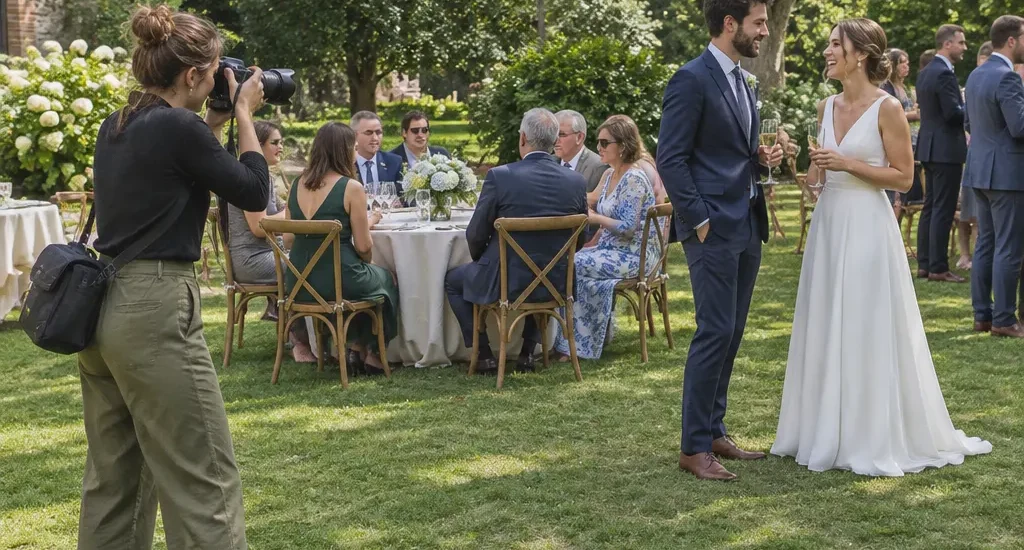
Why Candid Wedding Photos Often Beat Posed Ones
A candid wedding photograph records an unscripted moment, such as a shared laugh, a tearful embrace, or a glance between partners. Candid images often feel more personal than posed portraits because they preserve real reactions and relationships, while posed photographs remain valuable for family groupings and formal keepsakes. Wedding-industry surveys and photography guidance consistently emphasize that couples want both meaningful moments and polished portraits; the strongest coverage combines the two. Understanding how candid photography works, what it captures, and how to balance it with direction helps couples plan images that feel emotionally true without missing important people or traditions.
Why candid wedding photography creates stronger emotional records
Candid wedding photography is an approach in which the photographer observes and documents events with minimal interruption, rather than arranging every subject and expression. Wedding photographer and educator Susan Stripling describes documentary coverage as watching for genuine moments and anticipating what may happen next. In practice, candid does not mean careless or entirely unplanned: photographers still manage timing, light, positioning, and camera settings, but they avoid directing the emotional content of each frame.
This approach can make images feel immediate because the viewer sees people responding to one another instead of responding to a camera. The U.S. wedding industry’s scale helps explain the demand for varied coverage: The Knot’s 2024 Real Weddings Study reported an average U.S. wedding cost of $33,000, based on its survey of couples married in 2023. With substantial time and money invested in the day, photographs serve not only as portraits but as a record of experiences that cannot be repeated.
Emotional authenticity and memory
Emotional authenticity is the sense that a photograph reflects a real response rather than a requested expression. A parent’s reaction during a ceremony, friends laughing during a toast, or a couple pausing together after the formalities can communicate the atmosphere of the event in a way a fixed smile may not. Research on autobiographical memory, including work by psychologist Elizabeth Loftus, shows that memory is reconstructive rather than a perfect recording; photographs therefore become cues that help people revisit particular details and conversations. They cannot reproduce the full experience, but expressive images can make recollection more vivid.
Relationships, context, and storytelling
A candid image often includes more than the couple: it can show how relatives, friends, and guests relate to them. A sequence of photographs may follow the day from anticipation to ceremony, celebration, and farewell, giving individual moments a larger narrative context. This is one reason documentary-style wedding coverage can feel distinctive: the photographer records not just what the event looked like, but how people experienced it.
That story-driven approach leads naturally to the different kinds of candid images couples may want. Some depend on close observation, while others require subtle guidance or careful planning to ensure key people and events are not overlooked.
How candid wedding photography captures meaningful moments
Candid wedding photography includes several related approaches: documentary coverage, photojournalistic storytelling, and lightly directed interactions. These are not rigidly defined industry categories, and photographers may use the terms differently. Their shared principle is to preserve natural behavior while making thoughtful choices about timing, composition, and access.
Documentary and photojournalistic coverage
Documentary wedding photography records the day as it unfolds, with limited staging. Photojournalistic coverage applies a related emphasis on observation, decisive timing, and visual sequences that communicate events. Examples include a quiet moment before the ceremony, guests reacting to a speech, or the movement and energy of a dance floor. The photographer’s craft remains active: anticipating a moment, choosing an angle, and working in available light all shape the final image.
Unscripted portraits and gentle direction
An unscripted portrait is a couple or group photograph made with little posing, often while people walk, talk, or share a private moment. Gentle direction—such as asking a couple to take a short walk together—can create space for genuine interaction without prescribing a facial expression or gesture. This middle ground is useful for couples who want portraits that feel relaxed but still benefit from flattering light, a clear background, and considered composition.
Guest reactions and the wider celebration
Guest-reaction photographs widen the story beyond the couple. They may show a grandparent watching the ceremony, friends greeting one another, children playing, or a room responding to a toast. These moments can be especially meaningful for couples who cannot speak with every guest during a busy celebration. A second photographer can help cover simultaneous events and different parts of a venue, although whether one is worthwhile depends on the guest count, schedule, and budget.
When posed wedding photographs still matter
Posed wedding photographs are images in which the photographer arranges people, posture, or composition to achieve a planned result. They are not inherently less meaningful than candid images. Formal portraits provide clear records of family members and wedding-party groupings, and they can be especially important when relatives travel long distances or when older guests may not be available for future gatherings.
Family portraits and essential keepsakes
A planned family-photo list helps ensure that important combinations are photographed efficiently. Couples can identify essential groupings in advance, appoint a relative who knows both families to help gather people, and reserve a defined time in the schedule. This preparation reduces the chance that a key portrait is missed and leaves more of the celebration available for natural coverage.
A balanced approach to posing
A balanced wedding gallery commonly includes formal portraits, lightly directed couple photographs, and documentary coverage. The proportions depend on personal priorities: a couple who values family records may set aside more portrait time, while one who prefers an unobtrusive record may emphasize candid coverage. There is no universal evidence-based ratio that suits every wedding; the practical measure is whether the plan reflects the couple’s preferences and includes the people and moments they consider essential.
For example, a couple might schedule a brief set of family portraits immediately after the ceremony, then allow the photographer to observe the reception without interrupting conversations. This combines the reliability of planned images with the spontaneity that makes candid photographs compelling.
How couples can plan for better candid wedding photos
Candid photographs depend partly on the photographer’s skill and partly on the conditions of the day. Clear communication, a workable timeline, and a comfortable atmosphere give unscripted moments room to happen. Couples do not need to perform for the camera; they do need to make sure the photographer understands what matters to them.
Choose a photographer whose approach fits
Review full wedding galleries rather than relying only on selected portfolio images. Look for emotional range, consistent exposure in different lighting, respectful handling of ceremonies, and evidence that the photographer can make formal portraits as well as spontaneous images. During a consultation, ask how they work during sensitive moments and how they coordinate with planners, venues, and other vendors.
Build a realistic timeline and shot list
A realistic schedule reduces the pressure to rush from one photograph to the next. Share the ceremony and reception timeline, identify non-negotiable moments, and provide a concise family-group list. Allowing a little transition time can also help prevent portraits from cutting into the ceremony or celebration. These details support unobtrusive coverage because the photographer can anticipate where to be instead of improvising around avoidable delays.
Create space for natural interaction
Couples can help candid images emerge by spending time with guests, allowing a few quiet pauses, and choosing a photographer who communicates calmly. Venue lighting, room layout, and restrictions on movement can affect the photographer’s options, so discuss them beforehand. The goal is not to manufacture emotion but to make it possible to notice and preserve it.
Conclusion: candid and posed photographs serve different purposes
Candid wedding photographs often stand out because they preserve genuine reactions, relationships, and the atmosphere of a day that cannot be staged again. Documentary and photojournalistic coverage can tell a broader story, while gently directed images offer a relaxed bridge between spontaneity and portraiture. Posed family photographs remain important for reliable keepsakes and clear records of loved ones. Couples planning a wedding should review complete galleries, communicate their priorities, and build a timeline that leaves room for both formal portraits and unscripted moments. The best next step is to discuss those priorities with a photographer and create a coverage plan that feels true to the people getting married.
Sources: The Knot, 2024 Real Weddings Study, https://www.theknot.com/content/real-weddings-study; Susan Stripling, The Wedding School, https://www.theweddingschool.net/; Elizabeth F. Loftus, “Planting Misinformation in the Human Mind: A 30-Year Investigation of the Malleability of Memory,” Learning & Memory, https://learnmem.cshlp.org/content/12/4/361.full
