
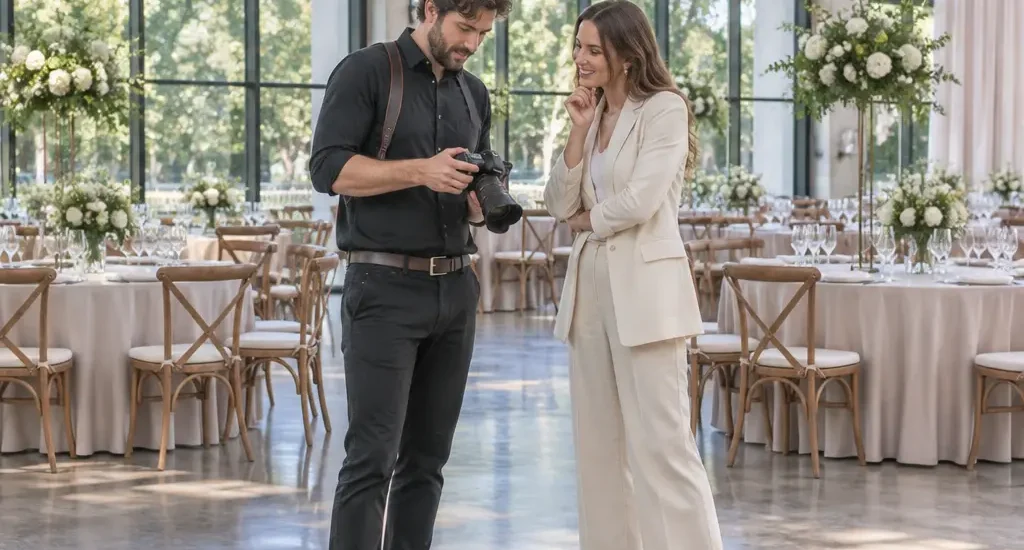
How to Find a Photographer Who Matches Your Vision and Venue
A photographer who matches your vision and venue is one whose style, experience, working approach, and practical setup fit the images you want and the conditions of your event or session. Find that match by defining your priorities, reviewing complete galleries from comparable venues, checking relevant experience and logistics, and discussing expectations before booking. This matters because photographs are lasting records: the U.S. Bureau of Labor Statistics describes photographers’ work as creating images for a range of purposes, while the Professional Photographers of America (PPA) emphasizes that professional services involve more than simply taking pictures. The guide below explains how to assess photographic style, venue fit, portfolio evidence, communication, and contract details.
Assess photographer style against your visual vision
A photographic style is the photographer’s consistent approach to lighting, composition, color, subject direction, and image editing. There is no universal industry definition that determines whether a style is right for a client; in practice, it is a set of visual choices you can evaluate across a photographer’s work. The most useful test is whether you like the photographer’s full galleries—not only a handful of standout images—and can picture those choices serving your own event or project.
Identify the style characteristics you want
Common style categories include documentary or candid photography, which prioritizes observed moments; editorial photography, which uses deliberate composition and direction; portrait-led work, which emphasizes posed subjects; and fine-art photography, which often favors controlled composition and a distinctive visual treatment. These are useful descriptors rather than strict, mutually exclusive classifications: a photographer may combine several approaches.
Before contacting photographers, collect a small set of reference images and note what you respond to—such as natural expressions, dramatic shadows, bright colors, muted tones, or formal portraits. Treat references as a way to explain preferences, not as a demand to reproduce another photographer’s work. Ask how the photographer would adapt those ideas to your venue and timeline.
Review complete galleries, not just highlights
A curated portfolio shows a photographer’s strongest selected work; a full gallery reveals how consistently that work holds up across changing light, locations, and moments. Request one or more complete galleries from events or sessions similar to yours. Look for variety, coherent editing, usable images in difficult conditions, and a balance between planned photographs and spontaneous moments.
Compare like with like: an outdoor ceremony in afternoon sun does not fully demonstrate performance in a dim indoor venue. If your event includes a dark reception, a small room, or mixed lighting, ask to see examples made under those conditions. This provides more relevant evidence than a general claim of versatility.
Match photographer experience and equipment to the venue
Venue fit means the photographer can work effectively within the location’s lighting, space, access, schedule, and rules while making images consistent with your priorities. The venue is not just a backdrop: its layout and conditions affect where photographs can be made, what equipment is practical, and how much time is needed. A photographer’s relevant experience is therefore more informative than a broad statement that they have worked in many locations.
Check experience with comparable spaces and lighting
Share the venue name, event schedule, and any known constraints. Ask whether the photographer has worked there or in a comparable space, such as a low-light ballroom, a bright glass atrium, a narrow historic interior, or an exposed outdoor site. If the photographer has not worked at that exact location, ask how they would prepare and what they would need to confirm in advance.
The U.S. Bureau of Labor Statistics notes that photographers may work indoors or outdoors and that lighting conditions can vary with assignments. For a client, the practical implication is to discuss the actual conditions rather than assume one portfolio image represents performance everywhere. Ask how the photographer handles backlighting, changing weather, restricted movement, and mixed artificial and natural light.
Confirm venue rules, access, and contingency plans
Venue policies may govern flash, tripods, drones, restricted areas, setup time, or movement during a ceremony or presentation. Confirm these rules with the venue and photographer before booking. For outdoor work, discuss a rain or extreme-weather plan, possible indoor alternatives, and who makes the final decision if conditions change.
A short venue walkthrough can help identify useful portrait locations, travel time between spaces, and potential obstacles. If an in-person visit is not practical, a floor plan, recent photographs, or a video call can still support planning. Build these details into the schedule so that photographs do not depend on unrealistic transitions.
Evaluate communication, services, and professional fit
Professional fit combines the photographer’s creative approach with reliability, communication, and clearly defined services. The PPA’s client education materials encourage consumers to understand a photographer’s services and business terms before hiring. A good conversation should clarify not only whether you like the images, but also how the photographer plans, works with people, and handles the finished photographs.
Discuss working style and people management
Some photographers offer frequent direction and carefully arranged portraits; others work unobtrusively and intervene mainly when needed. Neither approach is inherently better. Explain how comfortable you and your guests or subjects are with posing, how much candid coverage you want, and whether anyone needs accessibility accommodations or extra time.
During an introductory call, notice whether the photographer listens, asks relevant questions, and explains their process clearly. Ask who will actually photograph the event if a studio or company is being hired, and how substitutions are handled. These answers help establish whether the working relationship suits your needs.
Compare deliverables, timing, and contract terms
Photographers’ packages can differ in coverage hours, number of photographers, editing, image delivery, prints, albums, licensing, and travel costs. Ask for an itemized proposal and written answers about what is included. Clarify the expected delivery timeframe, how images will be provided, whether printing is permitted, and what happens if the photographer becomes ill or an event is postponed.
A signed agreement should identify the parties, date and location, services, fees and payment schedule, cancellation or rescheduling terms, image-use permissions, and backup arrangements. Review the contract rather than relying on verbal assurances. The exact legal requirements vary by location, so seek local professional advice if a term is unclear or consequential.
Use a practical selection process
A structured comparison reduces the chance of choosing on price or a single striking photograph alone. Use the same questions for each candidate, then compare evidence against your priorities. The following checklist can help:
- Define the images you value most, such as candid moments, portraits, architectural details, or product images.
- Shortlist photographers whose full galleries show a compatible visual style.
- Review work from similar venues, lighting, and event formats.
- Confirm venue permissions, access, schedule, and weather or equipment contingencies.
- Discuss communication, direction, backup coverage, editing, and delivery expectations.
- Compare written proposals and signed contract terms, not just headline prices.
For example, a couple planning a ceremony in a dim historic hall might prioritize a photographer with complete galleries from similarly dark interiors, experience working within venue restrictions, and a plan for portraits in nearby available light. A brand planning a product shoot in a bright studio might instead prioritize controlled lighting, consistent color, and examples of work for a similar visual purpose. In both cases, the strongest match is demonstrated by relevant work and a credible plan—not by venue familiarity alone.
A comparison chart can make the decision easier: list each photographer in a column and score style, comparable venue experience, communication, deliverables, and contract clarity against your own priorities. The chart is a decision aid, not an industry-standard rating system; weight the factors that matter most for your project.
Conclusion: choose a photographer whose work and process fit
Finding a photographer who matches your vision and venue means aligning visual style with demonstrated experience, then confirming that communication, logistics, and contract terms support the work. Define the images you want, inspect complete galleries made in comparable conditions, verify venue requirements, and discuss deliverables in writing. Start by contacting a short list with your date, venue, priorities, and questions; the quality of the photographer’s answers will help you judge whether the creative match is also a practical one.
Sources: U.S. Bureau of Labor Statistics, Photographers, Occupational Outlook Handbook, https://www.bls.gov/ooh/media-and-communication/photographers.htm; Professional Photographers of America, Find a Photographer, https://www.ppa.com/find-a-photographer; Professional Photographers of America, Photography Contracts, https://www.ppa.com/benefits/business-education
